
Table of Contents
- Quick Comparison: Best Curated Tech Deal Sites for 2026
- Greenmatrax.com: Curated Tech Discovery Without the Noise
- Woot: Amazon-Owned Flash Sales for Deep Discounts
- DealNews: Editorial Vetting and Price History in One Place
- CamelCamelCamel: The Dedicated Price Tracker for Amazon Shoppers
- Rakuten, Honey, and Offers.com: Cashback and Coupon Tools Compared
- Amazon Warehouse: Open-Box and Refurbished Tech With Full Returns
- How to Spot Fake Tech Deals Before You Buy
- Frequently Asked Questions
Last Updated: September 10, 2026
Quick Comparison: Best Curated Tech Deal Sites for 2026
The best curated tech deal sites in 2026 are Greenmatrax.com, Woot, DealNews, and CamelCamelCamel, with Rakuten, Honey, and Offers.com rounding out the cashback side of the category. What separates them is how much human vetting sits behind each listing. At Greenmatrax.com, we review and select gadgets before they ever reach the page, which matters because a deal is only useful if the product is worth owning.
That distinction has real consequences. FTC guidance on deceptive pricing and fake reference prices warns shoppers that an inflated “original price” is itself a form of deception, not a marketing quirk. In practice, this means the site you trust matters more than the discount percentage it advertises.
Below, we break down how each platform works, where it falls short, and how to spot a fake tech deal before you pay.
| Site | Best For | Editorial Vetting | Price History | Cost |
|---|---|---|---|---|
| Greenmatrax.com | Curated gadget discovery | Yes, hand-selected | No | Free |
| Woot | Flash sales on overstock | Limited | No | Free |
| DealNews | Vetted deals with context | Yes | Yes | Free |
| CamelCamelCamel | Amazon price tracking | No | Yes | Free |
| Rakuten | Cashback on purchases | No | No | Free |
| Honey | Automatic coupon testing | No | Partial | Free |
| Offers.com | Broad coupon coverage | Partial | No | Free |
| Amazon Warehouse | Open-box and refurbished | No | No | Free |
Greenmatrax.com: Curated Tech Discovery Without the Noise
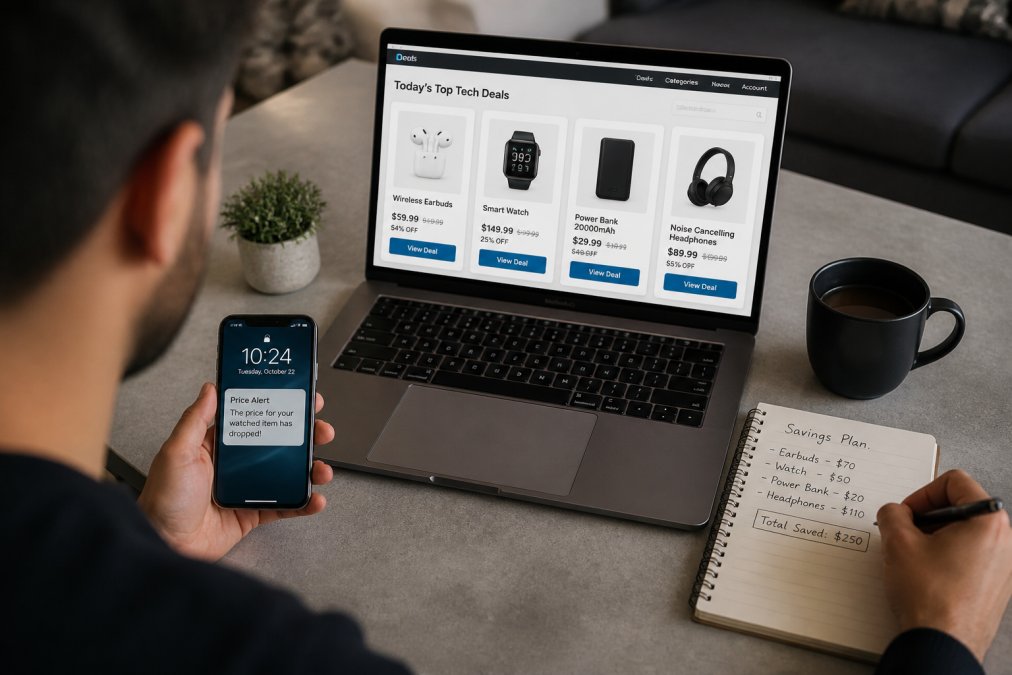
Greenmatrax.com is a curated tech discovery platform that aggregates gadgets and smart devices in one place, reviewing each selection before it appears. The value here is subtraction: fewer listings, each one chosen because it offers genuine value and reliable performance.
Most deal aggregators optimize for volume. That model works if you already know exactly what you want. It fails the moment you are shopping for a video editing peripheral or a smart home device and have no baseline for what “good” looks like. The Greenmatrax.com approach targets that second scenario directly, cutting the time spent cross-checking multiple websites.
Curation is the feature. A site that shows you 40 deals has done less work than one that shows you 6 and can explain why each made the cut.
Woot: Amazon-Owned Flash Sales for Deep Discounts
Woot runs daily flash sales with limited inventory, and its Amazon ownership shows up in two places: account login and logistics. Deals sell out fast because stock is genuinely finite, not artificially throttled.
The trade-off is predictability. You cannot plan a purchase around Woot the way you can around a price tracker, because inventory rotates daily and popular items vanish within hours. Bargain hunters who check it regularly do well; occasional visitors mostly miss.
DealNews: Editorial Vetting and Price History in One Place
DealNews pairs human editorial vetting with price history data, which is the combination most competing sites lack. Editors filter out low-quality listings, and the price context tells you whether a discount is real.
The honest limitation: fewer total deals than community-driven forums. If you want maximum volume, this is not it. If you want to stop sifting through junk, the trade is worth making.
CamelCamelCamel: The Dedicated Price Tracker for Amazon Shoppers
CamelCamelCamel tracks historical Amazon prices and sends email alerts when an item drops, making it the cleanest answer to “is this actually a discount?” Its browser extension puts the price chart directly on the product page.
The constraint is scope. It only covers Amazon inventory, so it does nothing for Best Buy, Newegg, or manufacturer-direct sales. Use it as a verification layer, not a discovery engine.
Rakuten, Honey, and Offers.com: Cashback and Coupon Tools Compared
Cashback portals and coupon tools are not deal sites. They are discount layers you apply on top of a purchase you have already decided to make. Understanding how each one actually pays out, and how they interact with each other, is what separates a real 12% savings from a 2% rebate that never clears.
Rakuten works as a shopping portal: you click through from Rakuten to a participating retailer, complete the purchase in that same session, and earn a percentage back as a rebate. Rates fluctuate by retailer and category, often spiking during seasonal promotions. The mechanics matter more than the headline rate:
- The rebate is paid quarterly, not at checkout, so you are floating the discount for weeks or months.
- Tracking depends on the click-through cookie or app session. If you open the retailer in a different browser, use a saved cart from a prior session, or apply a competing extension at checkout, the purchase can fail to register.
- Returns and cancellations reverse the rebate, and some retailers exclude gift cards, digital goods, and clearance items from eligibility.
Honey (owned by PayPal) takes the opposite approach. Instead of paying you back later, it tests coupon codes automatically at checkout and applies whichever ones work. It also surfaces “Honey Gold” rewards at select retailers and can show price-drop alerts on watched items. The limitations are structural: it can only test codes the retailer’s checkout accepts, so expired or single-use codes fail silently, and it does not negotiate a lower price, it just tries codes you could have tried yourself.
Offers.com is a promo-code aggregator rather than a checkout tool. It indexes codes across thousands of retailers and labels them by verification status, but verification is not a guarantee. A common pattern is a code that worked for one shopper on one cart configuration and fails for everyone else. Treat the listing as a lead, not a promise.
Can you stack them?
Stacking is where most shoppers lose money by assuming it works. The general rules:
- Portal cashback plus a coupon code usually stacks, because the code changes the price and the portal pays on the final total.
- Two cashback portals never stack. You must pick one click-through, and whichever portal you clicked last typically wins the tracking.
- A cashback portal plus a competing browser extension frequently breaks tracking. Many portals explicitly void rebates when a third-party coupon tool is active at checkout.
- Store credit, gift cards, and manufacturer rebates are separate from portal cashback and follow their own terms.
| Tool | What It Does | How You Get Paid | Main Drawback |
|---|---|---|---|
| Rakuten | Cashback rebates via portal click-through | Quarterly payout | Tracking can fail; returns reverse it |
| Honey | Auto-applies coupon codes at checkout | Instant price reduction | Only works if a valid code exists |
| Offers.com | Aggregates promo codes | Instant, if the code works | Codes expire or are single-use |
Cashback and coupons reduce what you pay. They do not tell you whether the product is any good or whether the price was inflated to begin with. Layer them on top of a curated source, not in place of one.
One more caveat worth checking before you rely on any of these: some retailers exclude certain categories, often laptops, game consoles, and Apple products, from cashback entirely. Read the retailer’s portal terms, not just the advertised rate.
Amazon Warehouse: Open-Box and Refurbished Tech With Full Returns
Amazon Warehouse sells returned, open-box, and refurbished items at a discount, each graded by condition and backed by Amazon’s standard return policy. For shoppers comfortable with open-box electronics, this is often the steepest legitimate discount available.
The catch is inventory. Stock is unpredictable, so you cannot search for a specific model and expect it to be there. Check when you are flexible on model, not when you need one exact item.
Open-box savings disappear if the item arrives damaged and you miss the return window. Verify the condition grade and the return deadline before checkout, not after.
How to Spot Fake Tech Deals Before You Buy
Most guides tell you to “check the price history.” Few explain how, or what the history actually reveals. That is the gap this section fills: a concrete verification routine using price-history tools, plus the return and warranty risks that turn a discount into a loss.
Step 1: Verify the price, not the percentage
A “40% off” badge is meaningless without a baseline (the FTC). The baseline is the item’s own price history, and you can pull it in under a minute:
- CamelCamelCamel charts historical Amazon prices and lets you set email alerts for a target price. Paste the product URL and you see the all-time low, the average, and the current price on one graph. If today’s “deal” is above the 90-day average, it is not a deal.
- Keepa does the same for Amazon with a browser extension that overlays the price chart directly on the product page, plus a mobile app for alerts. It also tracks third-party seller pricing, which matters when the “deal” is from a marketplace seller rather than Amazon itself.
- Honey’s price history and similar extensions show a shorter window on select retailers, useful as a cross-check when CamelCamelCamel or Keepa do not cover the store.
A common pattern in fake reference pricing: the “original price” is set to the manufacturer’s list price, which the item has not actually sold at for months. The FTC’s guidance on deceptive pricing treats an inflated reference price as a form of deception, not a marketing quirk, so the retailer’s “was” price is not a neutral fact.
Step 2: Confirm the seller and the condition
- Check whether the seller is the manufacturer, an authorized retailer, or a third-party marketplace seller. Authorized sellers preserve the manufacturer warranty; marketplace sellers often do not.
- Read the condition grade. “Renewed,” “open-box,” and “refurbished” are not interchangeable. A manufacturer-refurbished unit usually carries a warranty; a third-party “renewed” listing may carry only a 90-day seller guarantee.
- Confirm the return window. Many discounted electronics carry a shorter return period than the standard 30 days, and some are final sale (consumer.ftc.gov).
Step 3: Check the warranty before you check out
This is the risk most deal sites skip. A steep discount on a laptop or phone is only real savings if the warranty survives the purchase. Two things to verify:
- Is the warranty transferable and intact? Some manufacturers void coverage on items sold by unauthorized resellers.
- Does the discount reflect a warranty reduction? A refurbished unit at 30% off with a 90-day warranty is a different product than a new unit at 30% off with a one-year warranty. Price the difference in.
Open-box savings disappear if the item arrives damaged and you miss the return window. Verify the condition grade and the return deadline before checkout, not after.
Step 4: Set an alert instead of chasing a countdown
Countdown timers and “stock running out” messages are pressure tactics, not information. The better move is to stop browsing and start watching:
- Set a price alert on CamelCamelCamel or Keepa for the exact model you want, at a target price you have validated against history.
- Use a deal site’s saved-search or notification feature to alert you when a specific product category, not a general feed, hits your threshold.
- Ignore flash-sale urgency unless the price history confirms the discount is real. A genuine all-time low does not need a timer to sell.
Refurbished and open-box listings often carry the same manufacturer warranty as new units. Check the warranty terms specifically, because that detail decides whether the discount is real savings or a gamble.
For timing, the best windows to buy electronics are typically major seasonal promotions and clearance events, when retailers move inventory rather than chase margin. Outside those windows, a price tracker is your best tool, and the alert, not the deal feed, is what actually saves you money.
Frequently Asked Questions
What is the best website for finding tech deals in 2026?
The best site depends on your shopping habits. Greenmatrax.com works well for curated, pre-vetted tech without the research burden. Woot offers deep discounts on overstock and refurbished electronics. CamelCamelCamel is ideal for Amazon price tracking. DealNews provides editorial oversight and price history data. For cashback, Rakuten and Honey add savings on top of existing purchases. Most shoppers use two or three of these together to cover different needs.
How do curated tech deal sites differ from general coupon aggregators?
Curated tech deal sites like Greenmatrax.com and DealNews manually review products before listing them, filtering out low-quality items and inflated discounts. General coupon aggregators like Offers.com cast a wider net across thousands of retailers but may include expired or unverified codes. Curated sites trade volume for reliability, which saves time if you want fewer but better options. Aggregators are better when you already know the exact product you want and just need a code.
How can I spot fake tech deals before purchasing?
Check the product’s price history using a tool like CamelCamelCamel to see if the ‘original price’ was ever actually charged. Look for verified discount badges on the deal site. Avoid deals that pressure you with countdown timers and limited stock claims unless the retailer is reputable. Cross-reference the same product on two or three sites. If the discount seems too steep for a current-generation item, it is likely a discontinued model or a third-party seller with questionable warranty coverage.
What is the best time of year to buy electronics?
Black Friday and Cyber Monday still deliver the deepest discounts on consumer electronics, but Amazon Prime Day in July and back-to-school sales in August offer strong deals on laptops and tablets. New model releases, typically in September and October for smartphones, push previous-generation prices down. January clearance events clear out holiday overstock. For the best electronics price tracking results, set price drop alerts in advance and buy when the price hits a historical low, not just when a sale banner appears.
Are curated tech deal sites safer than general marketplaces?
Curated sites reduce risk because someone has already vetted the retailer and the product listing. Greenmatrax.com reviews and selects products for genuine value, which lowers the chance of encountering counterfeit goods or misleading specs. General marketplaces host third-party sellers with varying reliability. That said, always check the return policy and warranty terms regardless of where you buy. Amazon Warehouse, for example, offers full Amazon returns on open-box items, which adds a layer of protection that many third-party sellers do not.
Tech deal hunting rewards patience and verification more than speed. Greenmatrax.com was built for exactly that: a curated feed of carefully reviewed gadgets, aggregated so you are not opening twelve tabs to compare the same product. Find the best tech products without wasting time, and get access to daily deals at genuinely competitive prices. Start with Greenmatrax.com and let the curation do the filtering for you.