Table of Contents
- Quick Comparison: Top Tech Picks for Digital Professionals
- Ergonomic Tech Accessories for Professionals: Comfort Meets Productivity
- Best Productivity Gadgets for Remote Work: Tools That Keep You Focused
- Essential Home Office Tech Setup: Build Your Ideal Workspace
- Must-Have Tech for Digital Professionals: Security and Authentication
- Must-Have Tech for Digital Professionals: Audio, Connectivity, and Mobile Essentials
- Budget-Friendly Tech Picks and Smart Integration for Digital Professionals
- Conclusion: Building Your Must-Have Tech Stack
- Frequently Asked Questions
Last Updated: September 13, 2026
Quick Comparison: Top Tech Picks for Digital Professionals
This guide from Greenmatrax.com breaks down the must have tech for digital professionals in 2026, from input devices that protect your wrists to security keys that protect your data. The best setup is not the most expensive one, it is the one where every component removes friction from your day.
Below are our top picks for remote work, security, audio, and budget-conscious buyers, plus the integration mistakes that quietly cost teams hours every week.
| Category | Top Pick | Why It Wins | Best For |
|---|---|---|---|
| Laptop | Apple MacBook Neo | Long battery life, color-accurate display | Creative and heavy multitasking work |
| Audio | Sony WF-1000XM6 | Class-leading noise cancellation | Open offices and shared spaces |
| Webcam | Logitech Brio 505 | Reliable low-light image, privacy shutter | Frequent video calls |
| Charger | Nekteck 60W GaN | One brick replaces three | Travel and cable management |
| Security | Bluetooth tracking tag | Cheap insurance for expensive gear | Frequent travelers |
Ergonomic Tech Accessories for Professionals: Comfort Meets Productivity
Ergonomic tech accessories for professionals are the difference between finishing a nine-hour day fresh and finishing it with a numb wrist. A mechanical keyboard with proper key travel and a vertical or split mouse reduce repetitive strain.
Ergonomics is also a workflow decision: when your input device fits your hand, you stop correcting typos and move faster. It also means different hardware depending on where you work, a split keyboard that lives on a fixed desk is wrong for someone who hot-desks three days a week.
Match the accessory to your work environment
Dedicated home office. You have the desk depth for a full split keyboard, an ultrawide on a monitor arm, and a vertical mouse with a wrist rest. The biggest posture wins live here, because you set the geometry once.
Hybrid or hot-desk. Portability beats perfection. A low-profile mechanical keyboard (roughly 1.5 lbs) and a compact vertical mouse travel in a laptop sleeve, and a folding laptop stand gets the screen to eye level. Skip the monitor arm.
Frequent travel. Prioritize a lightweight keyboard with a built-in battery and a mouse that pairs over Bluetooth to two devices at once, so you can switch between a laptop and a phone without re-pairing. A travel wrist rest that rolls flat is worth the few ounces.
The mechanisms that actually matter
- Key travel and actuation force: Mechanical switches typically actuate between 45g and 55g (cherry.de). Lighter switches reduce finger fatigue for high-volume typists; heavier switches reduce accidental keystrokes for people who rest their hands on the keys.
- Tenting and split angle: A split keyboard lets you rotate each half outward so your wrists stay neutral instead of pronated. A 10-15 degree tent is the sweet spot before reaching the outer keys becomes awkward.
- Vertical mouse angle: A true vertical mouse holds your hand at roughly 90 degrees; a “vertical-style” mouse at 45-60 degrees is easier to adapt to and still relieves forearm twist (osha.gov).
- Monitor height: The top third of the screen at eye level keeps your neck neutral, the highest-return adjustment, and it costs nothing (the CDC).
Accessibility tech most guides ignore
Inclusive design hardware is a genuine gap in every competing list. If you have limited hand strength, low vision, or a repetitive-strain diagnosis, the right picks look different:
- One-handed keyboards and compact keypads keep the mouse hand free and reduce reach distance.
- Foot pedals mapped to modifier keys (Ctrl, Shift, Cmd) cut thousands of awkward finger stretches per day for people with limited dexterity.
- Large-print or high-contrast keycaps and backlit keyboards with adjustable brightness help low-vision users without a screen reader.
- Switch-accessible mice with programmable buttons support users who cannot perform a standard click-and-drag.
These are not niche luxuries. They are the difference between staying productive and having to stop working.
- Mechanical keyboard: Look for adjustable tilt and switches rated for long typing sessions
- Vertical mouse: Keeps your forearm neutral instead of twisted
- Monitor arm: Raises your ultrawide to eye level and frees desk space
- Footrest and wrist rest: Small additions that change your posture over a full day
Set your monitor arm so the top third of the screen sits at eye level, then lower your chair until your feet rest flat. Most people adjust the chair first, which is backwards.
Do not buy a split keyboard and a vertical mouse in the same week. Changing two input habits at once makes it impossible to tell which one is causing the new discomfort, and most people abandon both. Change one, give it two weeks, then change the other.
Best Productivity Gadgets for Remote Work: Tools That Keep You Focused
The best productivity gadgets for remote work solve a specific interruption problem rather than adding another screen to manage. Noise-canceling earbuds, a smart speaker for hands-free scheduling, and a tracking tag for your gear bag all qualify.
Sony’s WF-1000XM6 earbuds are the strongest pick for anyone working in a shared or noisy space: the active noise cancellation is genuinely effective and the microphone clarity holds up on conference calls. At around $299 they are a premium buy, but if you live on video calls, the difference is obvious.
Essential Home Office Tech Setup: Build Your Ideal Workspace
An essential home office tech setup starts with the machine you type on, then works outward to peripherals, power, and connectivity. The Apple MacBook Neo is our top recommendation for digital professionals who need sustained performance: high-efficiency silicon handles demanding software, the Retina display stays color-accurate for creative work, and battery life supports a full day away from a wall outlet.
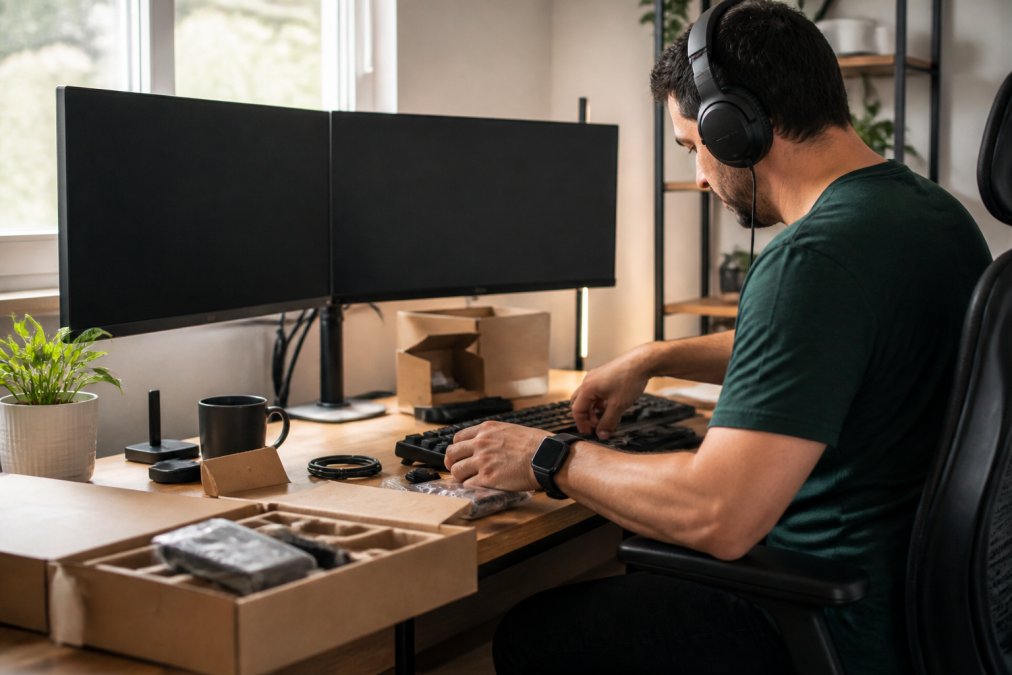
Pair it with the Logitech Brio 505 webcam if you present frequently. It delivers 1080p resolution, corrects for mixed office lighting automatically, and includes an integrated privacy shutter. Setup is plug-and-play, though it needs a stable USB connection.
Skipping a docking station to save money usually backfires. Unplugging and replugging five cables twice a day wears out ports and costs you minutes you never get back.
Must-Have Tech for Digital Professionals: Security and Authentication
Security is where most home office builds quietly fall apart. Hardware authentication, biometric login, and encryption are baseline requirements for anyone handling client data from home.
A hardware security key or biometric login removes the weakest link in most setups: reused passwords. Pair that with full-disk encryption on every portable device, and a lost laptop becomes an inconvenience instead of a breach. For professionals who travel with expensive equipment, a Bluetooth tracking tag is cheap insurance, though it depends on nearby devices to report its location.
Data privacy also extends to your peripherals. That privacy shutter on the Brio 505 matters more than most buyers realize, and so does firmware hygiene on routers and smart devices.
Must-Have Tech for Digital Professionals: Audio, Connectivity, and Mobile Essentials
Audio and connectivity gear determines whether remote collaboration actually works. A dropped call or laggy screen share costs credibility in a way a slow spreadsheet never does. The right stack depends on where you are working that day.
Audio: pick by environment, not by spec sheet
Open office or shared space. Active noise cancellation is the whole point. Sony’s WF-1000XM6 earbuds are the strongest pick here: the ANC is genuinely effective and the microphone clarity holds up on conference calls. At around $299 they are a premium buy, but if you live on video calls, the difference is obvious.
Home office with a door. You do not need class-leading ANC. A wired USB microphone plus open-back headphones often sounds better on calls than any earbud, because the mic sits closer to your mouth and the headphones do not fatigue your ears over a full day. It costs less than a flagship earbud pair.
Travel. Battery life and case size beat audio quality. Look for earbuds rated for at least 6 hours per charge with a case that adds two or three more, and confirm they support multipoint Bluetooth so you can stay connected to a laptop and a phone at once.
Connectivity: the layer that quietly breaks calls
If your router cannot prioritize latency-sensitive traffic, no amount of expensive desk hardware will fix a stuttering call.
- Wi-Fi 6 or Wi-Fi 6E router: Prioritizes video calls over background downloads and handles more simultaneous devices without dropping packets. Wi-Fi 6E adds a less congested 6 GHz band for apartment buildings.
- Ethernet where you can: A single cable to your primary work machine removes Wi-Fi from the equation entirely, the cheapest reliability upgrade available.
- Mesh node for hybrid homes: If your office is upstairs and the router is downstairs, a mesh node beats a range extender because it does not halve your throughput.
- Mobile hotspot as failover: A 5G phone or dedicated hotspot keeps you working when the primary connection drops. Set it up before you need it, not during an outage.
Mobile essentials: the backup device that earns its place
The Samsung Galaxy A17 5G is the value pick of this group. The 90Hz display keeps scrolling smooth, 5G handles mobile data, and the battery lasts a full working day. Camera performance is entry-level, the honest tradeoff at this price. It works as a dedicated hotspot, a backup device when your laptop fails, and a second-factor authentication phone.
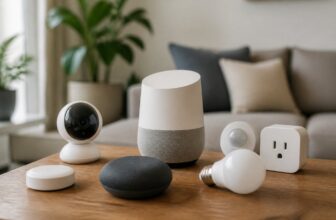
For desk-level automation, the Amazon Echo Dot handles reminders, calendar queries, and smart home office lighting without touching a keyboard. The tradeoff is the always-on microphone, so place it deliberately.
How these pieces integrate
The value of this stack is not the individual devices; it is the handoffs between them:
- Calendar-to-lighting: A smart speaker can trigger office lighting scenes at the start of a focus block, so you are not reaching for a switch mid-thought.
- Phone-to-laptop hotspot: When your primary connection drops, your phone’s hotspot can auto-join on your laptop, so failover happens without opening settings.
- Earbud multipoint switching: Multipoint lets the same earbuds answer a phone call and return to a laptop meeting without re-pairing, which matters more than any single audio spec.
- Charger consolidation: The Nekteck 60W GaN charger at roughly $35 replaces multiple power bricks, and gallium nitride shrinks the form factor so one adapter handles your whole bag.
Build the audio and connectivity layer around your worst working day, not your best one. If your setup survives a coffee shop with bad Wi-Fi and a shared space with background noise, it will handle a quiet home office without complaint.
- Noise-canceling earbuds: Sony WF-1000XM6 for focus and call clarity
- Smart speaker: Amazon Echo Dot for hands-free scheduling and smart home control
- 5G phone: Samsung Galaxy A17 5G at roughly $199 as a backup or hotspot
- GaN charger: Nekteck 60W USB-C replaces multiple power bricks
- Wi-Fi 6 router: Prioritizes video calls over background downloads
Budget-Friendly Tech Picks and Smart Integration for Digital Professionals
Budget-friendly picks work best when they plug into an existing ecosystem rather than fighting it. The Nekteck 60W GaN charger is the clearest example: gallium nitride shrinks the form factor, and 60W output covers most laptops and tablets, so one adapter handles your whole bag.
The Amazon Echo Dot does similar work on the software side, syncing calendars and controlling office lighting through third-party integrations. If you want a tactile, unusual option, the Lego Smart Brick offers programmable desk alerts and modular organization, though its utility is narrow.
| Pick | Approx. Price | Solves | Watch Out For |
|---|---|---|---|
| Nekteck 60W GaN charger | $35 | Cable clutter, travel weight | Capped at 60W output |
| Amazon Echo Dot | $49 | Hands-free scheduling | Always-on microphone |
| Bluetooth tracking tag | $29 | Lost gear while traveling | Needs nearby devices to report |
| Samsung Galaxy A17 5G | $199 | Backup device and hotspot | Entry-level camera |
The cheapest upgrade with the biggest daily impact is usually cable management plus a single GaN charger. It costs less than a mid-range peripheral and removes friction every single day.
Conclusion: Building Your Must-Have Tech Stack
The hard part is not choosing individual gadgets; it is assembling a stack where software, hardware, and network actually work together. Most professionals overspend on one flagship device and underspend on the peripherals and security that determine whether the setup holds up.
Greenmatrax.com exists to remove that guesswork. We aggregate carefully reviewed gadgets and smart devices in one place, so you can compare genuine value and reliable performance without trawling multiple sites for daily deals. Our platform focuses on three things: a simple and trustworthy shopping experience, finding the best tech products without wasting time, and access to daily deals at great prices. Get started with Greenmatrax.com and build a workspace that earns its place on your desk.
Frequently Asked Questions
What tech tools are essential for remote digital professionals?
Remote digital professionals need a reliable laptop like the Apple MacBook Neo for demanding software, noise-canceling earbuds such as the Sony WF-1000XM6 for clear calls, and a webcam like the Logitech Brio 505 for video meetings. Ergonomic accessories and a compact GaN charger round out a portable, efficient setup. Prioritize items that improve focus, connectivity, and comfort for long work sessions.
How do I choose the right tech for my digital workflow?
Start by identifying your biggest daily friction: if you struggle with background noise, invest in noise-canceling audio; if your laptop battery dies quickly, get a high-wattage charger. Match devices to your software ecosystem to avoid compatibility issues. For example, a MacBook pairs seamlessly with Apple accessories. Also consider portability and battery life if you work from multiple locations.
What are some must-have tech gifts under $200 for professionals?
The Amazon Echo Dot at $49 offers voice-controlled scheduling and smart home integration. A Bluetooth tracking tag at $29 keeps expensive gear secure during travel. The Samsung Galaxy A17 5G at $199 provides a budget-friendly secondary phone with 5G. These gifts balance utility and price, making them practical for digital professionals who value efficiency.
How can I ensure my home office tech setup supports productivity?
Focus on ergonomics and reducing distractions. An ultrawide monitor and mechanical keyboard improve comfort and multitasking. Cable management keeps your space tidy, while a docking station simplifies connecting peripherals. Use cloud-based syncing for seamless file access across devices. Regularly update firmware to maintain security and performance. A well-planned setup minimizes downtime and keeps you in flow.