Table of Contents
- Why Fake Tech Deals Are Everywhere
- How to Spot Fake Tech Deals: Verify the Seller First
- How to Identify Fake Online Electronics Stores
- Analyze the Deal Itself for Red Flags
- Evaluate Customer Reviews and Product Authenticity
- Use Price Tracking Tools to Verify Legitimacy
- How to Report Online Shopping Scams
- Payment Safety and Return Policy Traps
Last Updated: August 27, 2026
Why Fake Tech Deals Are Everywhere
Counterfeit electronics and fraudulent retailers have proliferated, with scammers replicating entire retailer layouts, SSL certificates, and AI-generated reviews. The problem: sophisticated fakes are now indistinguishable from legitimate sites. If a deal seems too good to be true, it almost always is, but you need concrete methods to verify legitimacy before spending hundreds of dollars.
This guide walks you through seven essential checks that separate real deals from scams: seller credentials, website security, pricing patterns, customer reviews, and return policies. By the end, you’ll have a systematic approach that takes less than five minutes and could save you from losing money or exposing your identity to cybersecurity threats.
How to Spot Fake Tech Deals: Verify the Seller First
Before examining the deal itself, verify the retailer exists and operates legitimately.
Check the retailer’s business registration and history
Search the company name plus "business registration" or "BBB" to find official filings. The Better Business Bureau provides ratings and complaint histories for thousands of retailers. If a company claims to be established but has zero BBB presence and no business registration records, that’s a red flag.
Look for specific details: incorporation date, physical address, and owner information. Fake retailers often use virtual addresses or residential locations. Cross-reference the address on their website with their business registration, they should match exactly.
Check domain age using WHOIS lookup tools. Domains registered within the last few weeks are suspicious, especially for high-ticket items. Established retailers own domains for years. A domain registered recently that’s already selling premium electronics is almost certainly a scam.
Look for secure checkout and SSL certificates
Legitimate online stores use HTTPS encryption, indicated by a padlock icon in your browser’s address bar. However, having an SSL certificate doesn’t guarantee legitimacy, many fraudulent sites purchase them to appear trustworthy.
Click the padlock icon and view certificate details. The certificate should be issued to the company name you’re buying from. If it’s issued to a generic name or different company, the site is using a borrowed or compromised certificate, a common phishing tactic. Also check the expiration date; expired certificates suggest negligence or intentional deception.
How to Identify Fake Online Electronics Stores
Website design and content quality reveal a lot about a retailer’s legitimacy.
Inspect the URL for phishing and lookalike domains
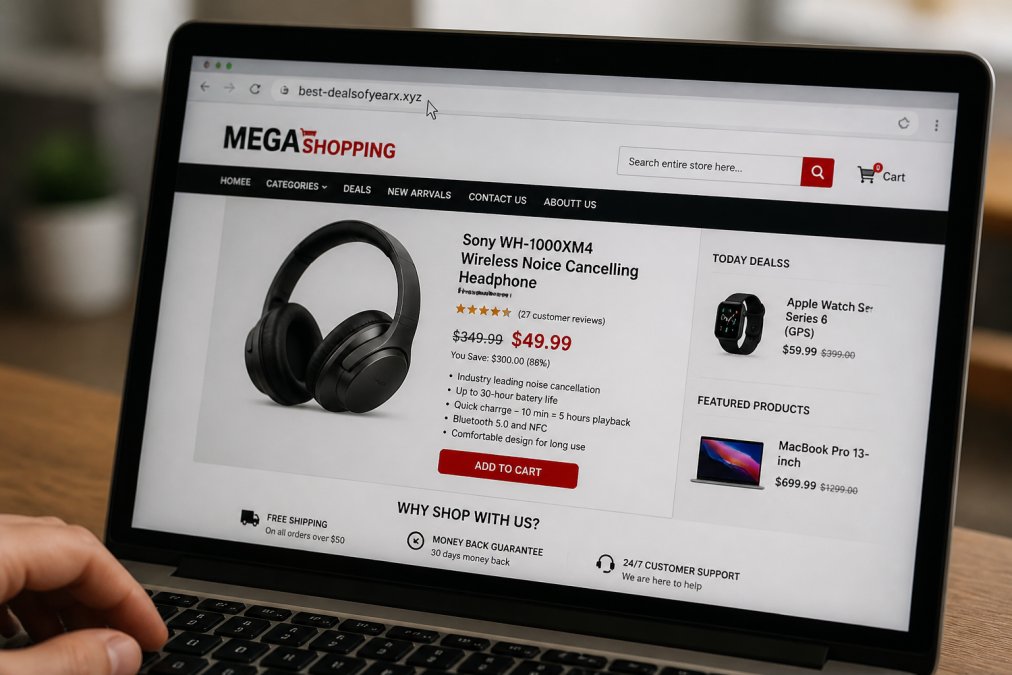
Phishing attacks use URLs that closely mimic legitimate retailers: "amaz0n.com" (zero instead of O) or "bestbuy-sale.com". Examine the domain name character by character, paying special attention to numbers resembling letters (0 vs O, 1 vs l, 5 vs S). Check for extra words inserted before or after the real domain.
Bookmark official websites of retailers you trust. When you find a deal, navigate through your bookmark rather than clicking email or ad links. This eliminates lookalike domain risk.
Examine website design, grammar, and professionalism
Professional retailers invest in their digital storefronts. Spelling errors, grammatical mistakes, and inconsistent formatting are immediate warning signs. Read product descriptions carefully for awkward phrasing, incorrect punctuation, or sentences that don’t make sense.
Check design consistency: Do all pages use the same font, color scheme, and layout? Fake sites often cobble together elements from multiple sources. Look for placeholder content like "Insert product description here", professional retailers remove these before going live.
Examine product images. Fake retailers often use low-resolution stock photos or images stolen from legitimate retailers. Do multiple products use the exact same image? That suggests inventory doesn’t actually exist.
Analyze the Deal Itself for Red Flags
Compare prices across official retailer sites
Take the exact model number and search for it on the manufacturer’s website and major authorized retailers. A legitimate deal will be discounted but not drastically underpriced compared to other retailers.
Use price tracking tools to see historical pricing. If the suspicious site lists an inflated "original price" that doesn’t match historical data, the discount is artificially inflated. Check multiple retailers, if the suspicious site charges $279 and most charge $299, that’s plausible. If it charges $199 and others charge $299, that’s suspicious.
Spot unrealistic discounts and dynamic pricing
Legitimate retailers don’t offer 70% discounts on current-generation electronics. They might offer 10-20% off during sales or 30% off clearance items. Seventy percent off a brand-new flagship device doesn’t happen in legitimate retail.
Fake retailers use dynamic pricing to inflate the "original price" and make discounts look more dramatic. A "flash sale" running for three weeks isn’t a flash sale. Legitimate flash sales target specific products and rotate regularly.
Verify model numbers and product specifications
Counterfeit products often have slightly different model numbers from genuine versions. Cross-reference the model number on the product listing with the manufacturer’s official specifications. The specifications should match exactly.
Check warranty information. Legitimate retailers provide manufacturer warranties matching what the manufacturer offers. If the seller claims a warranty better than the manufacturer provides, that’s suspicious.
Evaluate Customer Reviews and Product Authenticity
Detect AI-generated and fake reviews
AI-generated reviews have distinctive patterns: overly formal language, lack of specific details, or generic praise applicable to any product. Genuine reviews include specific use cases: "I use this laptop for video editing, and the 16GB RAM handles 4K files without lag."
Look for reviews that repeat the product name awkwardly. Genuine reviews use pronouns like "it" or "this." Check review dates, if a product launched two weeks ago with 500 five-star reviews, something’s wrong. Legitimate products accumulate reviews gradually.
Examine reviewer profiles. Do reviewers have other purchases and reviews, or is this their only review? Fake review operations create accounts just to post a single review.

Check for verified purchase badges
Verified purchase badges indicate the reviewer actually bought the product from that retailer. If a product has dozens of five-star reviews but none have verified purchase badges, that’s a major red flag. Combine the verified purchase badge with content quality, both should align.
Use Price Tracking Tools to Verify Legitimacy
Services like CamelCamelCamel (for Amazon products) and Keepa show exactly how a product’s price has fluctuated over time. If a retailer claims an original price of $799 but price tracking shows it’s never sold for more than $499, you’ve caught a scam.
Price tracking helps identify whether a deal is actually a deal. A 10% discount might sound modest, but if the product is already at a historic low, it’s not much of a bargain. Set price alerts for products you’re interested in, let tools find deals for you rather than hunting through scams.
How to Report Online Shopping Scams
File a report with the Federal Trade Commission at reportfraud.ftc.gov. Include the retailer’s URL, products, payment amount, and what went wrong. The FTC aggregates reports and shares patterns with law enforcement.
Report the fraudulent website to your payment processor. Contact your credit card issuer or PayPal to report the transaction through their fraud reporting system. Report the domain to its registrar using WHOIS lookup. If the scam involved a lookalike domain, report it to the trademark holder, Amazon, Apple, Microsoft, and other major brands actively pursue domain registrars to take down lookalike sites.
Payment Safety and Return Policy Traps
Use credit cards rather than debit cards for online purchases. Credit card companies offer stronger fraud protections. Avoid wire transfers, gift cards, and cryptocurrency, these payment methods are irreversible.
Examine return policies carefully. Legitimate retailers offer returns within 30 days, often with free return shipping. Fake retailers often have restrictive policies: no returns within 14 days, returns only for defective items, or return shipping costs charged to customers. Look for evidence that the retailer processes returns through customer reviews mentioning successful returns.
Finding genuine deals requires vigilance, but the process becomes faster with practice. By implementing these verification steps, checking seller credentials, examining website security, comparing prices, analyzing reviews, and reviewing return policies, you can confidently identify legitimate offers and avoid scams. At Greenmatrax.com, we curate tech deals through this exact lens, ensuring every recommendation meets these standards. Our platform aggregates verified deals from trusted retailers so you can shop with confidence. Start by bookmarking official retailer websites and using price tracking tools. When you’re ready to discover deals already vetted by our team, explore Greenmatrax.com’s curated selection of genuine tech products and daily deals.
| Verification Step | What to Check | Red Flag Indicator |
|---|---|---|
| Seller Verification | Business registration, BBB history, domain age | No registration records, new domain, zero BBB presence |
| Website Security | HTTPS/SSL certificate, certificate issuer match | No padlock icon, certificate issued to different company |
| URL Inspection | Exact domain spelling, lookalike variations | Numbers replacing letters, extra words in domain |
| Design Quality | Grammar, spelling, image quality, consistency | Spelling errors, stock photos, placeholder content |
| Price Comparison | Historical pricing, comparison across retailers | 50%+ discount, inflated "original price" |
| Model Verification | Exact model number match, specification accuracy | Model number doesn’t exist, specs don’t match |
| Review Analysis | Verified purchases, specific details, review dates | No verified badges, generic language, sudden spikes |
| Return Policy | 30-day returns, free return shipping, enforcement | No returns, restocking fees, ignored requests |
According to FTC guidance on online shopping safety, verifying seller credentials and checking for secure checkout are the first lines of defense against fraud. The National Retail Federation’s cybersecurity report notes that counterfeit electronics cost consumers billions annually, making verification essential. Research from Internet Crime Complaint Center data on e-commerce fraud shows that price comparison and review verification are among the most effective consumer protection tactics.
Use a dedicated email address for online shopping. This isolates your primary email from marketing lists and makes it easier to spot phishing attempts. Scammers often target addresses with fake order confirmations and password reset links.
Never click links in emails claiming to be from retailers. Even if the email looks legitimate, navigate directly to the retailer’s website by typing the URL yourself or using your bookmark. Email links are a primary phishing vector used to steal login credentials and payment information.
Frequently Asked Questions
Q: How can I tell if a tech deal is too good to be true?
A: Compare the advertised price against official retailer sites and price history databases. Discounts exceeding 40-50% on current-generation electronics often signal counterfeit goods, stolen inventory, or phishing scams. Check the model number against the manufacturer's website to confirm the product exists. Legitimate flash sales rarely last more than 24-48 hours and come from verified retailers, not unknown third-party sellers.
Q: What are the most common signs of a fake online electronics store?
A: Watch for poor website design, spelling and grammar errors, missing contact information, no physical address listed, and vague return policies. Fake stores often use lookalike domain names (e.g., 'amaz0n.com' instead of 'amazon.com') and lack SSL certificates (check for the padlock icon). They may pressure you with fake countdown timers, aggressive pop-ups, or limited-stock warnings. Verify the retailer's business registration through the Better Business Bureau or state commerce department.
Q: How do I report online shopping scams if I suspect I've been targeted?
A: Report the fraudulent website to the Federal Trade Commission (FTC) at reportfraud.ftc.gov. If you used a credit card, contact your card issuer immediately to dispute the charge and request fraud protection. Report the scam to the FBI's Internet Crime Complaint Center (IC3) at ic3.gov. Document all communications, screenshots, and transaction details. If the scam involves counterfeit goods, also report it to the brand's intellectual property team.
Q: Can I use price tracking tools to verify if a tech deal is legitimate?
A: Yes. Price tracking tools show historical price data and alert you when prices drop significantly. If a tool shows the item was never sold at the 'original' price the seller claims, the deal is likely fake. These tools also track prices across multiple retailers, helping you identify when one seller is offering an unrealistic discount compared to competitors. Legitimate deals typically align with price history patterns, while scams often show prices that never existed.
This article was written using GrandRanker